.jpg)
 English
 Français
 Deutsch
 Italiano
 Русский
 Español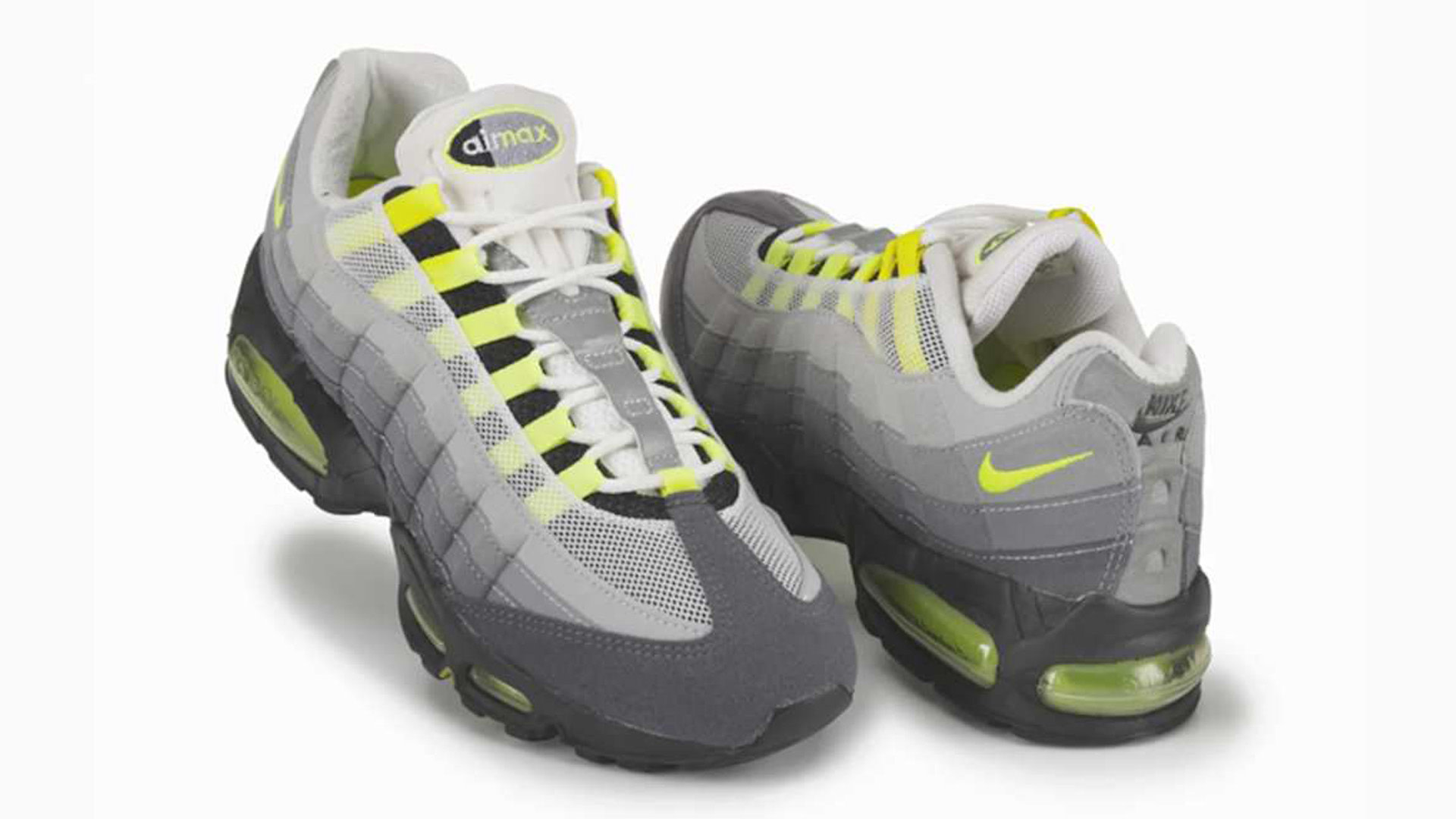

Sergio Lozano’s Nike Air Max 95 design is legendary enough to spawn its own myths.
It’s a shoe that means different things to different subcultures. To some, it’s an object of desire and to others, it’s something to deride. It’s been resold, stolen, rocked at multiple crime scenes, collaborated on, collected, discontinued, then resurrected.
Some people might have even run in a pair at some point too. For its 30th anniversary, the shoe finally came back with its original “Big Bubble” Air Unit in 2025, and has returned to glory thanks to a combination of new, returning, and collaborative colorways. With lots more on the way in 2026, we’re taking a look at 20 things you didn’t know about the Nike Air Max 95.
Editor’s note: Context has been updated to reflect the 2025 re-release of the “Big Bubble” Nike Air Max 95.
The 15 Best Nike Air Max 95s of All Time, Ranked
The Most Anticipated Sneakers of 2026
Given its crazed status in Japan, it’s little surprise that the Air Max 95 invaded popular culture with a vengeance. Even cool guy characters in teen-oriented manga wore a pair—not too much of a surprise given the volume of sport related titles (Slam Dunk anyone?) and the footwear-centric attention to detail from many artists. In the west, your leading character might have some skippies on to avoid a lawsuit, but these guys laced theirs in style. A Yu-Gi-Oh! collab eventually released in 2025.
We’ve had plenty of opportunities to get a pair of the palette that defined this shoe, even if some proved to be region-specific. Excluding remixes and the Mita “Black Tongue” sample, the famous neon AM95 makeup has been released at least 10 times over the last 30-plus years.
After its original 1995 appearance, it reappeared in 1997, 1998, 1999, 2003, 2006, 2008, 2010, 2012, 2015, 2020, and 2025. In that time, the PSI detail vanished (then reappeared this year) and the Air unit has become significantly smaller post-2003. In fact on the 2015 editions, the 5 PSI part of the bubble at the heel is barely visible from the side. That all changed thoughwhen the “Big Bubble” Nike Air Max 95 finally returned 2025.
The Game’s threat to, “kill you if you try me for my Air Max 95s” on “Hate It or Love” It is well-known, but known connoisseur Mighty Mi christening a reworking of Eastern Conference All Stars the Air Max 95 remix pre-dates it by a few years. Fan favorites Gucci Mane and Curren$y have name checked them too. Fabolous proclaimed that he has a Murciélago in matching green.
Oh, and just in case you didn’t realize that Game loves them, he mentioned them again on Dead and Red Nation. Big Pun wore a pair back in the day that supported his heavy frame, as did Ghostface, Raekwon, Fredro Starr, Lil Kim in her early Junior M.A.F.I.A. days, Eminem, Heather B, and Warren G. Despite those hip-hop endorsements, the biggest influencer for the shoe in terms of sales was still probably Sporty Spice who had a whole generation hunting for bubbles.
The Nike archive houses a pair of the underrated Air Max2, the shoe that debuted the dual chamber Nike Air used on the 95, with visible forefoot Air. While the AM95 debuted that technology, this one remains a mystery—was that innovation originally set to drop in 1994, or was it just a test prototype for the next installment? Only Nike knows.
Tinker Hatfield left the Air Max series in 1994, handing it to young designer Sergio Lozano for his time to shine. While Tinker has expressed admiration for the look of the shoe, speaking to Sneaker Freaker in 2012, he told them that, “[Sergio] took it in a non-runner direction, because clearly that upper was not meant for running.”
He has a point—with the Air Max 93 (one of his personal favorites) taking things in a more flexible, foot hugging direction, the Air Max 95 was a significantly bulkier creation. In a conversation with Sneaker Tokyo on the subject of the AM95, Hiroshi Fujiwara remarks, “I didn’t like them much.” Don’t expect an HTM edition any time soon.
The Air Max 95’s designer, Sergio Lozano, is the mind behind several other iconic Nike creations, having contributed to the Shox design as well as the superb ACG Air Mada design that, like the Air Max, became a best-seller. He also designed the Air Max 2003 and was part of the creative crew that generated much of Nike’s most innovative work prior to leaving the company in 2021.
By 1996, the Japanese appetite for deadstock sneakers had become global news. Enterprising American companies like Farley Enterprises and Michigan-based Small Earth started putting out calls for folks to search their attics for old shoes. While the emphasis was on 1980s designs, some ads indicated that the Air Jordan 11 and Air Max 95 were good money too.
That’s because the Air Max 95 sold out fast in cities like Tokyo, resulting in some crazy asking prices. Some accounts of the reselling market in Tokyo threw wild figures like $1,000-$3,000 for the original colorways. By 1998, as the hype died down in favor of other designs, AM95s in classic colors were advertised at twice the price of the newer Air Max 98 model, before things cooled in 1999 and Japan’s sneaker boom subsided in favor of heritage looks, just as the western world seemed to enter a hype age when it came to sports footwear.
For better or for worse, this shoe was an important chapter in the history of sneaker reselling.
The phenomenal success of the Nike Air Max 95 in the Far East seemed to catch Nike off guard. After a fairly quiet initial response, some celebrity co-signs in Japan caused a level of hype previously unseen—the Air Max boom had begun. Books and magazines dedicated to these tech running models were pumped out in 1996, adding fuel to the fire. Retro was a solid business at the time, but the Air Max series was still considered fairly contemporary.
While the Air Max 1 had been reissued in the mid-1990s, it was eight years old by that point, whereas this Air Max had barely been off the shelves. The AM95’s final colorways arrived in late spring 1996 before the shoe vanished to make way for the Air Max 96. By 1997, it was back. Arguably, the AM96—a fine design—suffered as a result of 95 mania.
In a conversation with Sneaker Tokyo, Harajuku sneaker retail legend Hidefumi Hommyo of CHAPTER recalls the 1997 reissue doing good business: “I’m pretty sure that we stocked 1,036 pairs of the Air Max 95. At a price of 30,000 yen [approximately $250 at time of writing] per pair, we sold out in three days.”
After the success of the Flightposite and Flight 98, as well as their use on the second iteration of the gold shoe for Michael Johnson in the Sydney Olympics (a showcase that was hampered by injury), zippers seemed like the new thing. Who needed laces anyway? In 2001 (and again in 2025), an Air Max 95 with a zipper fastening appeared on shelves in line with a new slew of zip-up performance pieces that have aged terribly.
Completely ignoring the fact that the rib-like lace stays are one of the best parts of the design, this monstrosity made little noise beyond post-millennial shouts of “What are thooooose?”
Long before you cautiously crept back from that drop with your bag concealed, sneaker robbers were on the prowl. New Yorkers are no stranger to the sock walk, but in the relatively low crime climate of Japan, it was more shocking. One incident in Osaka (“A Japanese teenage gang on Tuesday beat up three men and stole a pair of coveted Air Max brand sneakers from them, police said.”) was described as the nation’s first reported case of shoe robbery. But seeing as they were going for a G in second-hand condition, wearers should have been ready to regulate. The Game might have had a point.
Scarcity and high price is the bootlegger’s dream. If your boy went on vacation to Thailand or Vietnam back in the mid to late 1990s, their sordid party tales were often accompanied by the triumphant presentation of some questionable looking Air Max 95s bought for less than ten dollars at a night market because they were supposedly “factory seconds.”
Thus, we all became experts at identifying stitches and telltale lettering. Seeing as the shoe’s most famous editions were made of synthetic suede, quality dipped, and the shape changed in the early to mid 2000s on the real-deal, it got tougher and tougher to call. It used to be that the telltale discomfort was the giveaway on a fake AM95, but when a legit pair from Foot Locker wasn’t exactly a comfortable ride, boundaries blurred.
Beyond the multiple bootlegs, this classic got a needless boot treatment too. Despite its beautiful lines and iconic use of color, the Air Max 95 has been abused several times. This isn’t as bad as the zipper editions by any means, but the Zen Venti’s Bat boot looks are as bizarre as it gets. Released in 2007 (but rarely ever seen), they looked straight outta Canal Street. Points deducted for the junior-style lack of forefoot air too.
On Friday, May 12, 2000, the Air Max 95 caused a very brief, small-scale riot in the UK. It started with with a segment on British consumer rights TV show Watchdog that discussed the issue of squeaking bubbles on this shoe. Anyone who owned one of the many defect pairs around this time can attest to the maddening sound with every step. Encouraged by the report on the show, aggrieved owners took their shoes back to a Leeds branch of Foot Locker, and the situation quickly turned physical.
In the melee, a policeman was injured and eight people were arrested. According to The Independent, “Dozens of customers arrived at the Foot Locker store, in the St John’s shopping center, on Friday clutching trainers – of all ages – and demanding new ones. Staff refused to comply, tempers became frayed and the police were called. By noon the shopping center was closed.”
In the UK, the Air Max 95 has long held some criminal associations. Its hefty price tag affords it a certain status, and its footprint has been commonly spotted at crime scenes. According to a forensic science report from the mid-2000s, the 95 was trailing second in “typical pattern frequency distribution for footwear marks from a UK police force” at just 8% to the 10% of Marshall Mathers’ favorite sneaker, the Air Max LTD.
Third place went to the Adidas Campus with just 3%. In 2007, national UK newspapers reported that the Nike Air Max 95 footprint was number one on the police’s databases, with the LTD relegated to third behind the mighty Reebok Classic. For the crooks, it was probably a good thing that the squeaking bubble issue had been fixed by that point.
The Air Max 95’s influence on the DC Legacy shoe was pretty overt. Danny Way and Colin McCay’s dual signature model from 1998 was a high tech creation, with a TPU arch and plenty of shock absorbent properties, but the graduated layering on the upper and use of color on the original makeups were a clear tribute to a 1995 classic. When you saw members of the Beastie Boys rocking a pair during promo for Hello Nasty, you’d be forgiven for thinking that they were Nikes from a distance.
Even though the 95 name had become shorthand to identify this classic from the multitude of other Nike Air Maxes early on, officially, it was a different story. Originally, it simply read “Air Max” on the box. Boxes from 1997 read either Air Max SC (supposedly shorthand for Sports Classic, as opposed to the earlier SC on the Bo Jacksons that apparently stood for Strength and Conditioning and got really confusing when the Bo was released in the sports classic line) or, for some more premium editions, Air Total Max SC.
By 1999, the majority of labels on boxes (and bear in mind that there were a slew of editions by this point, from 3Ms, to NikeTown UK exclusives and leather remakes) read AIR MAX ’95. That didn’t stop a few AIR MAX SC or AIR MAX labels from slipping through, though.
You’re not officially balling until you paint your private jet in an appropriate “Comet Red” Air Max 95 colorway. There’s not a great deal of imagery of this aircraft beyond a picture of Eric Clapton and Hiroshi Fujiwara looking pleased in front of it, but it was presumably Nike property (unless it belongs to somebody who really likes running shoes). Incidentally, as well as getting his own makeup of the Presto, Clapton managed to get a handful of “EC” branded Air Max 95s made for him in grey and olive.
The Air Max 95 was never a cheap shoe. Of course, if you could avoid extra tax or knew an employee well, there was room to maneuver, because that $140 price tag was brutal. Now it’s $190—a $50 price hike over 30 years. In the UK, the shoe rose in price from £99 in 1995 to a steady £110 for years, to the point where the shoe was nicknamed the “110.”
The Air Max 95 didn’t just get excitable write-ups in style bibles of the time like The Face and Boon—it was praised far beyond the cool kid sector. Seeing as it was a running shoe, the performance reviews were all important and Runner’s World wrote, “Although still relatively beefy, the latest Air Max provides a much more responsive ride than previous models did.” Months after that positive review, Time magazine’s Best of 1995: Products feature in a December 1995 edition declared the Air Max 95 one of the year’s finest athletic designs.
Everyone knows about the “black tongue” sample that Sergio had on his desk for a Japanese magazine shoot, but sketches of the Air Max 95 display some interesting differences to the final release. As well as optioning a reverse fade from a white sole to a dark grey collar in contrast to the excellent (and functional) darker sole we know and love, “Air” was optioned to be embossed on the heel, right above the visible air unit. A subtle change, but on a formula we’ve grown so familiar with over 30 years, it proves unusually intrusive.
Read the full article here