.jpg.png)

 English
 Français
 Deutsch
 Italiano
 Русский
 Español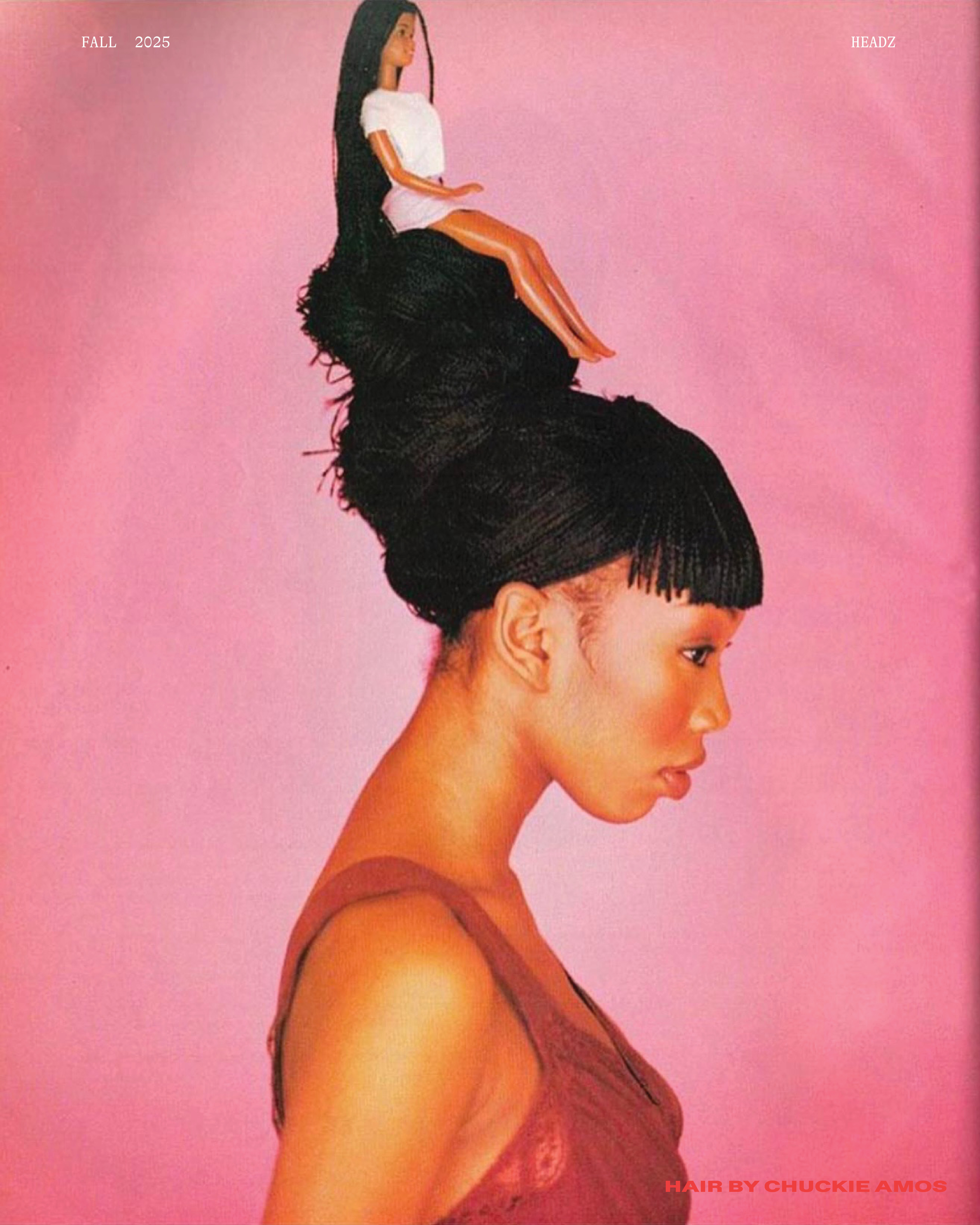

In 1994, Chuckie Amos was a student at NYC’s Fashion Institute of Technology, styling classmates’ hair for $10 a pop. One day, Amos’ friend tapped him to help on a magazine shoot. “I met a girl with braids,” Amos recalls—he styled her hair into Princess Leia buns for the cover. Unbeknownst to him, the girl with braids was Brandy Norwood. A year later, someone from Brandy’s team spotted Amos eating lunch at Rockefeller Center and remembered him from the shoot. Next thing he knew, he was streaking Brandy’s hair with threads of gold for the ’96 American Music Awards.
But as Amos put it, Brandy came with rules, and those rules came from “Mama No” (a nickname for Brandy’s mom, for Sonja Norwood). She erred on the side of caution, enforcing boundaries on her daughter’s look that sometimes made her look younger—a posture that anticipates and attempts to circumvent the ways young Black girls become the subjects of hypersexualization and adultification in their coming of age, which are risks only amplified by child stardom. Nevertheless, Brandy was equally entitled to experiment with her aesthetic and expression, and the most iconic site of that experimentation became her hair.
Amos says: “The record label said, ‘Forget that it’s braids—make it look like hairstyles that you would do with hair.’” For the rest of the decade, Amos would use the singer’s signature braids as a canvas for innovation—peep the ’60s-style volume in the “Sittin’ Up in My Room” video and the sparkly Rick James-inspired look in “Top of the World.” Though she preferred curtain braids or bangs to frame her face, she gave him free rein. Over time, as the artist continued to come into her own, the artist began implementing more of her own ideas. For her ’98 MTV VMAs performance of “The Boy Is Mine,” she asked Amos to twist her hair up into spikes—a look that launched an early-aughts trend into the stratosphere.
Amos went on to style Alicia Keys, Beyoncé, and other luminaries. But it all started with the girl with braids, who helped popularize a Black hairstyle for mass audiences. “We worked hard for her because we liked her a lot,” he says. “And we knew that we were all going places with Brandy, because she was it.”
How did you meet Brandy?
My friend, Danielle Robuck, had a little magazine that she was working on in Brooklyn called One Word Magazine, and it lasted maybe nine months. I was doing hair on campus at FIT, $10 a hairstyle. She said, “You do such great hair, I want you to do the cover of my magazine.” So I did her cover, and it was this girl with braids. I didn’t know who she was. I made Princess Leia buns, and they said it was going to be for a holiday issue, so I went to Michael’s and got little Christmas tree branches and little red boxes with the gold ribbons on them and put them all in the buns.I took the ends of her braids and put them at the top of her head to spread them out across her forehead, and made fake bangs. They loved that..
The cover came out. It said Brandy on the cover, and I was like, great, I have a cover. I literally had no idea who she was.
About a year later, in ‘95-’ 96, I was sitting in Rockefeller Center eating lunch and this girl walked up to me and said, “Oh my God, you did our artist’s hair.” She said, “Come with me, we’ve been looking for you.” We walked into the building, went upstairs on the 25th floor, the elevator opened up, and there were gold records on the wall. She said, “You did Brandy, you’re doing Brandy. Can you get to LA in four days?”
I love the hair from the “Sitting Up in My Room” video. Can you talk about that video?
I was also doing fashion shows in Europe with Orlando Pita, so we knew what was going on in fashion.I’m not sure if many people even know, but Gianni Versace and Dolce & Gabbana gave Brandy clothes for the video, so she’s only going to wear Versace and Dolce. I had done the Versace show with Orlando, so we recreated hairstyles that were created at the Versace show.
So Brandy’s wearing hairstyles from the Versace show in the video, but most people won’t know that because they’re not really looking for it.
If you look at the video, the style was to have volume in the hair, and braids don’t really have volume. So every two of her braids are wrapped around with a black elastic close to the roots as if it were a two-braid ponytail, so they would stick out. Brandy was so surprised. I’m kind of proud of that.
And obviously, those braid bangs were so popular at the time. What was the process of deciding on that look?
So Brandy had rules, and the rules of Brandy were from her mother, who was very strict. Sonya Norwood, we called her “Mama No” because “NO” was the first letters of the word Norwood and she would say no to everything. The record label came to me and said, “Brandy’s already looking like a little girl. We want you to make her hair look like hair, and do what hair would do, not braids.”
No one was really doing braid bangs back then. There were a lot of things that were not happening with braids. It was usually just buns, two ponytails, or just hanging down. The ends were burnt, and it was a blunt cut. Back then, they were only to the shoulder or collarbone. Brandy had hairstyles, and we did a lot of innovation with that.
Can you talk about some of her award show looks? Those were some major moments for her and her style influence.
I think it was the 1996 [American Music Awards]. She was accepting her award and did “Baby” live. They wanted me to lighten her hair because streaks were the thing that season.
I took my head form, a pin, a pack of hair her color, one color lighter, and then 27, which was even lighter, making it as if you did a foil dye. I made all those braids, burnt the ends to her length, and I strung them in with weave thread, so at the top of each braid I would make a knot. I would leave about an inch space, and I would wrap one braid around the root of her hair and it would come down and lay with the rest of the hair.
I do remember seeing streak braids in girls’ hair in the ‘90s, but it was usually one tone or two. Nobody mixed it to look like some of them were getting darker, and some of them are getting lighter. I captured it, and it looked like highlights.
As we move from the mid ‘90s towards the end of the decade, the braids start to get smaller, and ability to mimic hair with Brandy’s braids elevates even further. How did you guys evolve her braids? What were you doing to retain the health of her hair? Because she was doing really tiny braids and a lot of manipulation.
She was living in LA, and I was in New York, so I wasn’t around her head all the time for the health part of it. They were doing that on their own, which wasn’t great because as she was getting older, you’ll see more baby hairs because her ends were breaking off at the front. So I used the same technique that I did with the highlights, with just her regular braids around her hairline. I would take one braid, wrap the string around, and then bring it closer so it would fill in, where she was losing her hair.
I have to give it to Kim Kimble; she was the one who did her braids [on Moesha] and she was located in Los Angeles. I was only hired to style what she had, I never did the every day, or wash and condition. That was Kim Kimble. She would braid Brandy’s hair. For her second album, they did the micro braids.
The trick of Kim,which I never saw in my life, is she had micro braids on wefts of hair weave. I was amazed. Those [braids] were tracks sewn in on her hair, and it was all micro braids.
Later on I ended up making Brandy a bang out of those micro braid wefts. And we made a brandy doll And I used those little micro braid wefts to glue it onto this Barbie doll head to make it look like Brandy. Those micro braid wefts were really great. I still don’t see micro braid wefts. They were saving her hair.
And when you were saying that Brandy had rules, what were the rules?
If she had a miniskirt, and the shirt had a V-neck, the sleeves had to be long sleeves. If she had a miniskirt but a crew neck, she could wear short sleeves. If she had pants and they had long sleeves, she could do a V-neck.
Did Brandy have any rules herself about hair?
No. Brandy was just a doll, basically. Everyone had opinions, and everyone threw stuff on her and everyone told her what to wear, and she just did it. Brandy never had any say, really. She liked the braids. I would add something with bangs. Brandy’s only request was that she liked curtain braids to frame her face or bangs to frame her face and her eyes. Everything else was free range.
But when we did the live version of “Boy Is Mine” for the MTV Music Awards, which was the last time I did Brandy’s hair, I had [prepped] finger wave braids. I went to place them sideways on her hair, and she said, “I don’t want this.” She said, “No, I’ve been doing everybody’s styles and I’ve been doing what my mom wants, what you want, what everybody wants. And today I want to do what I want.” I said, “Okay, let’s do it. What do you want?” And she told me, she wanted me to twist it up, spike it up around her hair. In my eyes, I was like, what is she doing? But it actually started that 2000s trend where everyone was twisting their hair and having the spikes come out. I realized that Brandy was onto something and that she was another generation with a new idea.
What would you like to see done differently with the braided hairstyles of today?
There’s not enough short style braids, which I would love to see. I would love to see the length come away. People are not really interested in style and the quality, they’re into the quantity. It’s how many braids can I have? How long can I have them? I would like to see the boho braid trend end.
I think the short bobs of Living Single, I would love to see the ends burnt again instead of dipped. That would rock my world because I’d say, “Oh my God, that girl had a thought, she actually looked at one of the small percentage of pictures of past braids and said, I’m going to do that.”
How do you remember your time being a part of her team?
When it came to Brandy, the performer, the singer, the artist, she had a great team, and that’s what really made who Brandy was. We all worked together, and we worked hard for her, because we liked her a lot, and we knew that we were all going places with Brandy because she was it. Brandy had the vision. Not her mom. Not her parents. It was Brandy.
Check out more of Amos’ work in our special edition Headz zine, guest edited by Nikki Nelms, in Complex Magazine Issue No. 3. It’s available on Complex now.
Read the full article here